
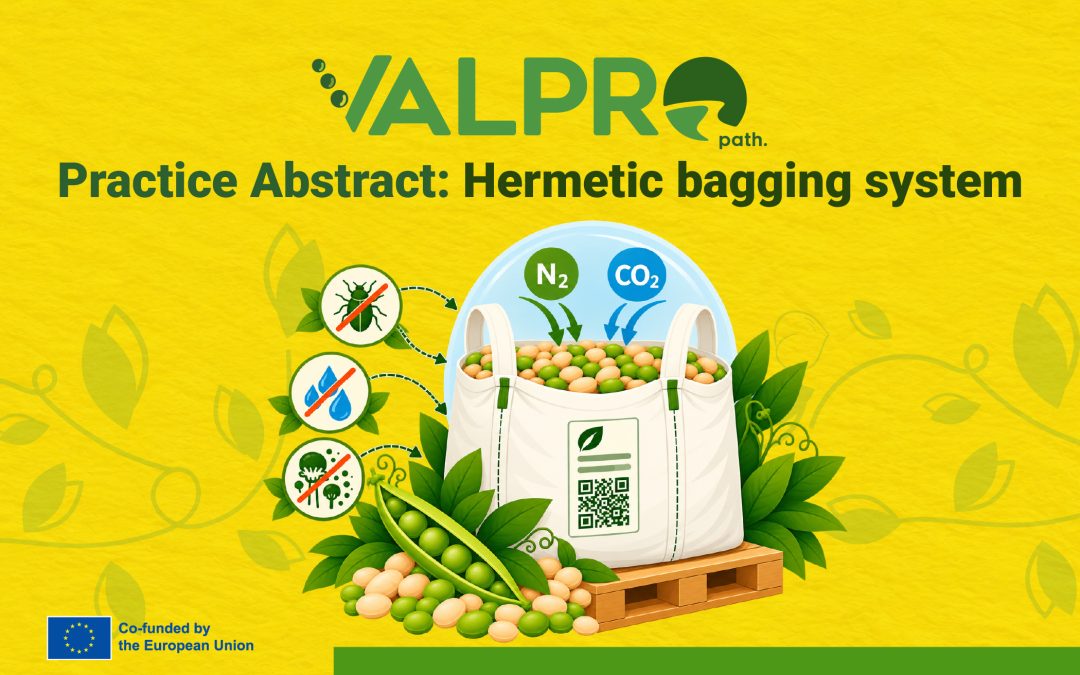
Keeping food-grade pulses and pulse flours safe and traceable from the field to the processor can be challenging, particularly for smaller and differentiated batches. Conventional silo storage can require significant investment and may result in mixing of lots, while smaller bags create additional requirements in handling and packaging. A flexible hermetic bagging system for storage and transport of food-grade pulses and flours is presented in this practice abstract by VALPRO Path partner University of Turin (UNITO).
The Problem
Food-grade pulses and pulse flours require to maintain a high level of product quality, safety and identity throughout storage and transport. However, conventional storage systems can be difficult to adapt to smaller or differentiated batches. Silos require substantial fixed infrastructure and make it harder to keep lots separate and traceable. Smaller bags offer greater flexibility, but require more handling and packaging and can leave products vulnerable to oxygen, moisture fluctuations, insects and fungi. These challenges are particularly important for organic producers, niche processors and plant protein value chains, where residue-free pest control and reliable traceability are increasing in importance.
How the Hermetic Bagging System Helps
The VALPRO Path solution combines a standard polypropylene raffia big bag with a capacity of approximately 500-750 kg with a low-cost polyethylene liner that can be sealed hermetically. After the bag has been filled, the integrity of the liner is tested by an automatic pressure decay test. A controlled atmosphere is then created in the bag by injection of carbon dioxide (CO₂) or nitrogen (N₂). A low-oxygen environment can help suppress insects and microorganisms, stabilise moisture and limit oxidative deterioration during storage. Crucially, each bag remains a separate and identifiable logistics unit and information on the field, variety, production practices and environmental indicators can therefore travel with the product throughout storage and shipment. It is also portable and modular and can be used for on-farm storage, temporary storage or direct shipment to mills and food processors without a dedicated silo.
Benefits
- Improved Product Protection: Storage with a controlled atmosphere can suppress insects and microorganisms while helping maintain stable moisture and product quality.
- Reduced Chemical Use: Hermetic storage can provide pest control without routine use of chemical insecticides or fumigants.
- Better Traceability: Each bag can remain an identifiable batch, helping to maintain information on the crop from field to processor.
- Flexible Storage: The modular system can be used on farms and during transport without need for permanent silo infrastructure.
- Reduced Handling: Large storage units require less handling than multiple smaller bags, allowing differentiated batches to remain separate.
- Longer Shelf Life: By limiting moisture changes, insect activity and oxidative deterioration, the system can help preserve product quality during storage.
Trials have shown complete insect mortality under the tested controlled-atmosphere conditions while untreated controls showed insect multiplication. After four months of storage, moisture was stable and there was no fungal growth detected. For farmers and processors, this can provide opportunities to preserve food-grade pulses and flours while maintaining batch identity and entering higher-value markets including organic and gluten-free products. The system can also help to promote more sustainable storage by reducing post-harvest losses and the need for repeated chemical treatments. By preserving more edible product, it can help ensure that the land, water, fertiliser and energy invested in production is not lost through spoilage. However, the environmental performance of the system depends on factors such as the production and reuse of liners, gas consumption, transport and recycling. By using recyclable materials, preventing liner damage and establishing appropriate recovery routes, the environmental benefits of using this system can be maximised. By combining hermetic storage, controlled-atmosphere, pest management and batch-level traceability, this approach offers a flexible solution for protecting food-grade pulses and supporting more efficient and sustainable plant protein value chains.
Discover how hermetic bagging can help to improve the storage, traceability and sustainability of pulse value chains. Read the full Practice Abstract below.
Subscribe to get all the latest information,
news & other insights about VALPRO Path