
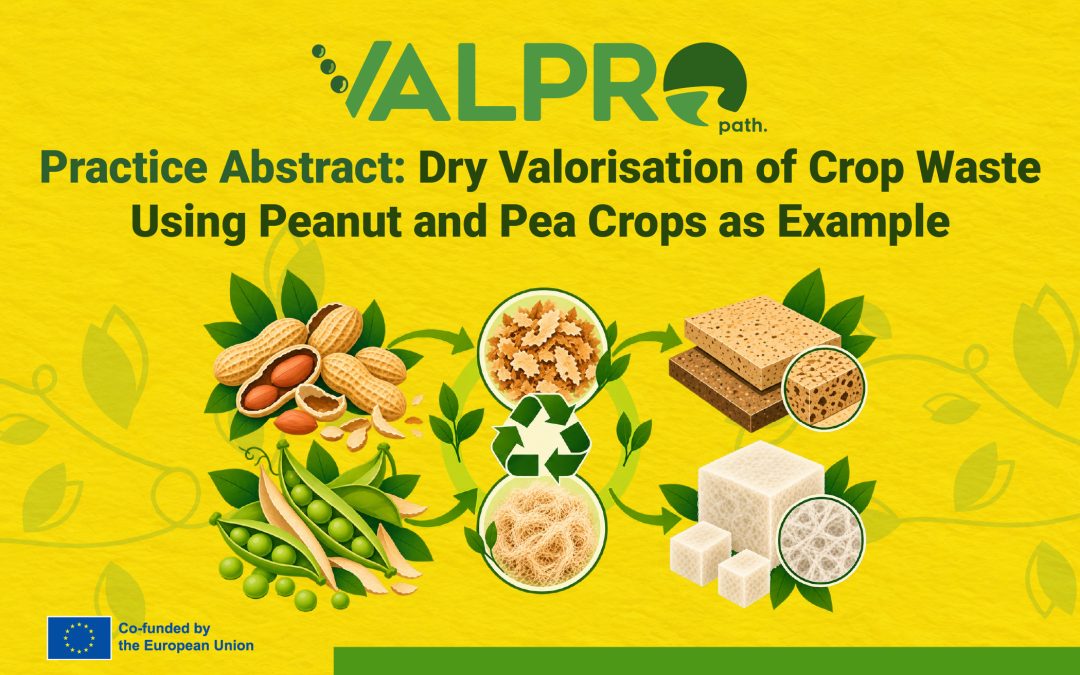
The production and processing of many crops can generate large amounts of agricultural waste, such as peanut shells and pea pods. These materials are often poorly valorised or used in low-value applications, despite their high potential. An integrated valorisation strategy to develop high-value sustainable materials from peanut shells and pea pods is proposed by VALPRO Path partner CSIC.
The Problem
Agricultural wastes generated during the production and processing of many crops, including peanuts and peas, should be considered as a valuable resource for the development of new materials. However, their current level of use is frequently low, and they can be found in low-value applications or not used at all.
At the same time, there is a growing need for sustainable alternatives to plastics and other materials with a high environmental footprint. However, agricultural wastes are diverse in terms of their composition and properties, and their use for specific purposes requires an adequate choice of processing techniques.
The development of approaches to transform them into high-value products can help to ensure a sustainable peanut and pea industry while contributing to a circular economy.
How Dry Valorisation Can Help
Researchers from CSIC proposed to use peanut shells and pea pods as a renewable resource for the production of biocomposites and aerogels with high added value. First, the team analysed the chemical and physical properties of these agricultural wastes to identify their key characteristics and select the most promising options for subsequent use.
The peanut shells and pea pods were transformed via two different approaches. In the first case, researchers used these agricultural wastes as lignocellulosic fillers for thermoplastic biocomposites. Particular attention was paid to selecting the optimal processing conditions to obtain materials with the desired properties.
In the second case, the scientists produced fibre aerogels from peanut shells and pea pods. To do this, they studied the properties of cellulosic fibre suspensions and developed special drying conditions. Thus, researchers have demonstrated that peanut shells and pea pods can be used to produce a wide range of biocomposite materials with high added value.
Benefits
- Waste Reduction: Peanut shells and pea pods can be redirected from disposal or low-value applications to valuable material products.
- Reduced Reliance on Fossil Resources: Bio-based fillers and structures can replace a proportion of fossil-based and non-renewable raw materials.
- Resource Efficiency: Making use of crop residues helps to extract greater value from agricultural biomass and supports more circular production systems.
- New Economic Opportunities: Scalable processing routes could open up new markets for farmers, processors and bio-based industries.
- Sustainable Materials: Biocomposites and aerogels made using agricultural residues could contribute to lower-impact material production.
To support wider adoption, the research recommends consistent characterisation and quality control of crop residues, as well as standardised drying, pre-treatment and milling procedures. Collaboration between farmers, processors and material manufacturers will also be important for establishing reliable supply chains and ensuring traceability.
Further pilot-scale validation and techno-economic assessment will help to determine how these approaches can be scaled up and integrated into existing peanut and pea processing chains.
The valorisation of peanut shells and pea pods could also deliver environmental benefits by reducing waste, retaining biogenic carbon in longer-life materials and replacing part of the fossil-based resources used in material production. Ongoing work will assess carbon footprint, energy demand and life cycle impacts to identify opportunities for maximising these benefits.
By transforming agricultural residues into biocomposites and lightweight aerogels, this approach demonstrates how crop waste can become a valuable resource and contribute to more circular, resource-efficient and sustainable peanut and pea value chains.
Discover how dry valorisation can transform agricultural side streams into high-value sustainable materials. Read the full Practice Abstract below.
Subscribe to get all the latest information,
news & other insights about VALPRO Path