
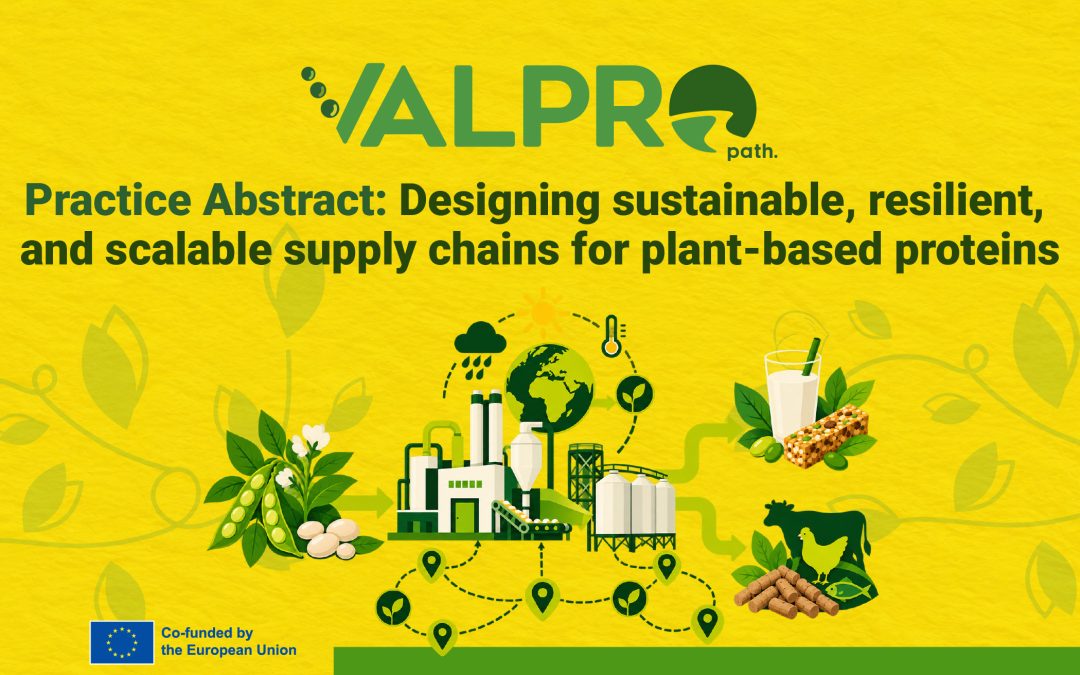
Europe’s shift towards plant-based proteins is dependent on increasing the domestic production of legumes and other protein crops, but there are several challenges associated with that. These include a lack of processing and storage infrastructures, limitations linked to climate change, and deciding whether to use these proteins for food or feed purposes. The Practice Abstract discusses how complementary modelling approaches can address these challenges to make legumes’ supply chains more sustainable, resilient, and scalable in this practice abstract written by VALPRO Path partner Wageningen University & Research.
The Problem
Europe’s plant protein supply chains are currently fragmented and underdeveloped, which limits the continent’s ability to scale up domestic production of legumes and other protein crops. This creates a challenge for policymakers, who are striving to make the continent less dependent on imported protein sources. The reasons for this issue include the absence of sufficient processing and storage infrastructures, which makes balancing food and feed protein difficult. Besides, climate change impacts legume crops, leading to losses due to extreme weather events. Another challenge is that it is unclear whether the processing infrastructure should be designed as a network of small-scale hubs or large-scale industrial plants to meet the needs of various actors in the supply chains.
How the Modelling Approach Helps
Researchers developed a pair of complementary modelling approaches to demonstrate how legume supply chains can become more resilient and scalable. The first approach is focused on intercropping of peas and fababean and considers the risks posed by wind lodging. The scientists evaluated how the probability of lodging affects the sorting and processing of legume crops and their distribution between food and feed chains. The Practice Abstract presented a case study of applying the developed method to an Italian region, which demonstrated how intercropping legumes can help create more sustainable supply chain networks. The second approach considered the issue of infrastructure resilience and scalability, addressing how to design supply chains in which local processing hubs balance the costs and benefits of decentralised and centralised options. Faba bean cultivation in Ireland is used as an example to illustrate the opportunities for processing and storage infrastructure, considering the phasing of production growth rates.
Benefits
- Enhanced Economic Value: Shifting legumes from low value bulk feed to higher value food and feed such as isolates can increase the economic value generated from domestic land use.
- Reduced Waste: Adequate and strategically planned drying and storage capacity can reduce spoilage, especially high moisture harvest years.
- Greater Climate Resilience: More diversified processing networks can see weather damaged crops diverted to feed while higher quality crops are retained for human food.
- Scalable Supply Chains: The modelling approaches can help to identify production levels at which processing technologies such as dry fractionation, wet extraction and heat treatments can become viable.
- Lower Environmental Impact: Local processing can reduce transport emissions and reduce the risk of spoilage from transporting high moisture crops.
The research also highlights the opportunity to diversify harvest windows and reduce weather related losses using intercropping systems. This could reduce the reliance on synthetic fertilisers through the inclusion of nitrogen fixing crops.
By considering economic, environmental and climate factors, the modelling approaches can help support the development of more sustainable, circular and resilient plant protein supply chains across Europe.
Discover how supply chain modelling can support the scaling-up of European plant protein production. Read the full Practice Abstract below.
Subscribe to get all the latest information,
news & other insights about VALPRO Path