
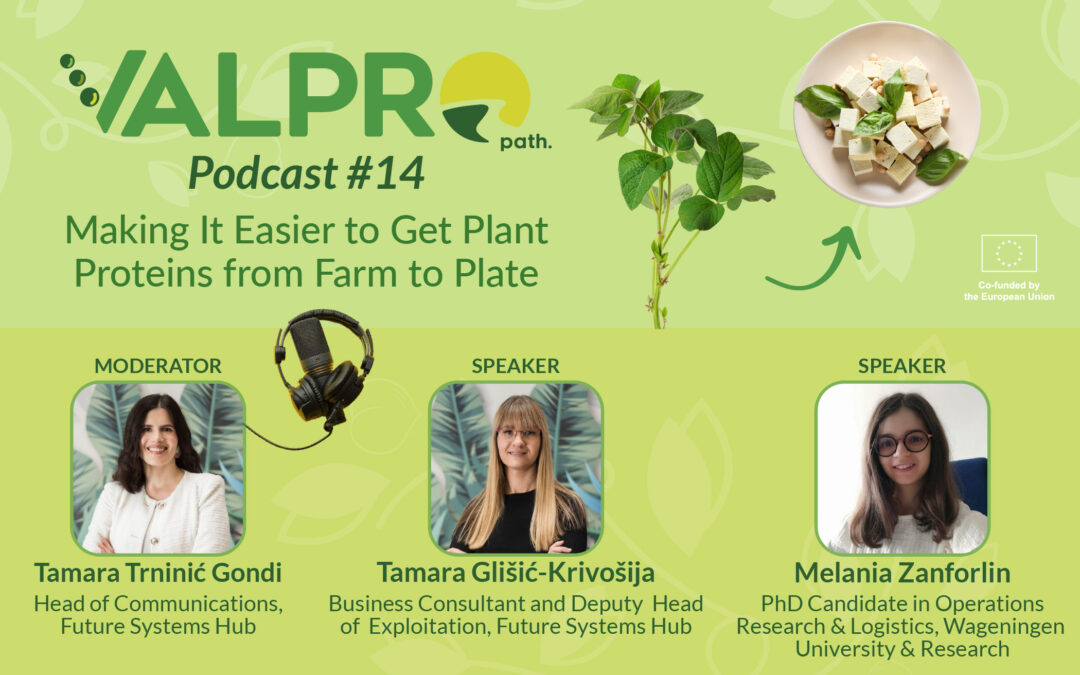
What does it take to build a plant protein system that works from farm to plate?
In the latest VALPRO Path podcast, VALPRO Path experts discussed the practical challenges and innovations shaping Europe’s plant protein transition, from short and decentralised supply chains and processing technologies to intercropping, supply chain optimisation and new plant-based food applications.
Hosted by Tamara Trninić Gondi from Future Systems Hub, the episode brought together Melania Zanforlin, PhD candidate at Wageningen University & Research, and Tamara Glišić-Krivošija, Deputy Head of Exploitation at Future Systems Hub, to explore how different parts of the plant protein value chain can be better connected.
Understanding the challenges across the value chain
Melania Zanforlin spoke about the importance of supply chain design and optimisation for the European plant protein transition. Short, decentralised supply chains better support regional economies but have limitations because of the characteristics of raw materials and processing infrastructure.
“Decentralization is great for local economies and can reduce the need to transport heavy, sometimes wet or even watery materials with unrefined biomass over long distances.”
At the same time, Melania pointed out that decentralisation also involves trade-offs, particularly around economies of scale, protein yields, and environmental objectives. Her work within VALPRO Path uses mathematical models and real-world data to explore how different supply chain configurations can perform under conditions such as climate uncertainty, changing consumer demand and different processing pathways.
Connecting the missing links
Tamara Glišić-Krivošija talked about VALPRO Path approaches, including the Innovation Production Systems, that support the development of more integrated systems.
“Within the project, we are trying to connect the missing links across the plant protein value chain. We are tackling different parts of the value chain, but not individually, through an integrated collaborative approach.”
She also explains how the project is testing different processing technologies for legumes and developing ingredients ranging from flours to concentrates and isolates, with applications including legume-based pasta, plant-based beverages, bars and veggie burgers.
Listen to the full podcast
The podcast also explored VALPRO Path business cases focused on on-farm processing, European peanut production, intercropping peas and faba beans, and the use of legume flours in food products.
Together, the speakers show how innovation across farming, processing and food production can help address some of the bottlenecks currently limiting the development of European plant protein value chains
For more insights, watch the full VALPRO Path podcast on YouTube:
Subscribe to get all the latest information,
news & other insights about VALPRO Path